
There is a version of AI tools that exists mostly in demos. Clean inputs, perfect outputs, confident verdicts. Nobody is losing money in those demos. The real workflow looks different.
One of us scalps gold on the 1 minute. The actual pre-trade checklist is fast, messy, and happens in a few seconds: is price respecting structure, is the session active, is the setup fresh or is it a retrace of something that already played out. The mental load is not the checklist itself. It is running that checklist at speed while the candle is closing.
That is the problem Leverage was built to solve. Not to replace your read, but to run alongside it, fast enough to be useful in the moment rather than a post-session analysis tool.
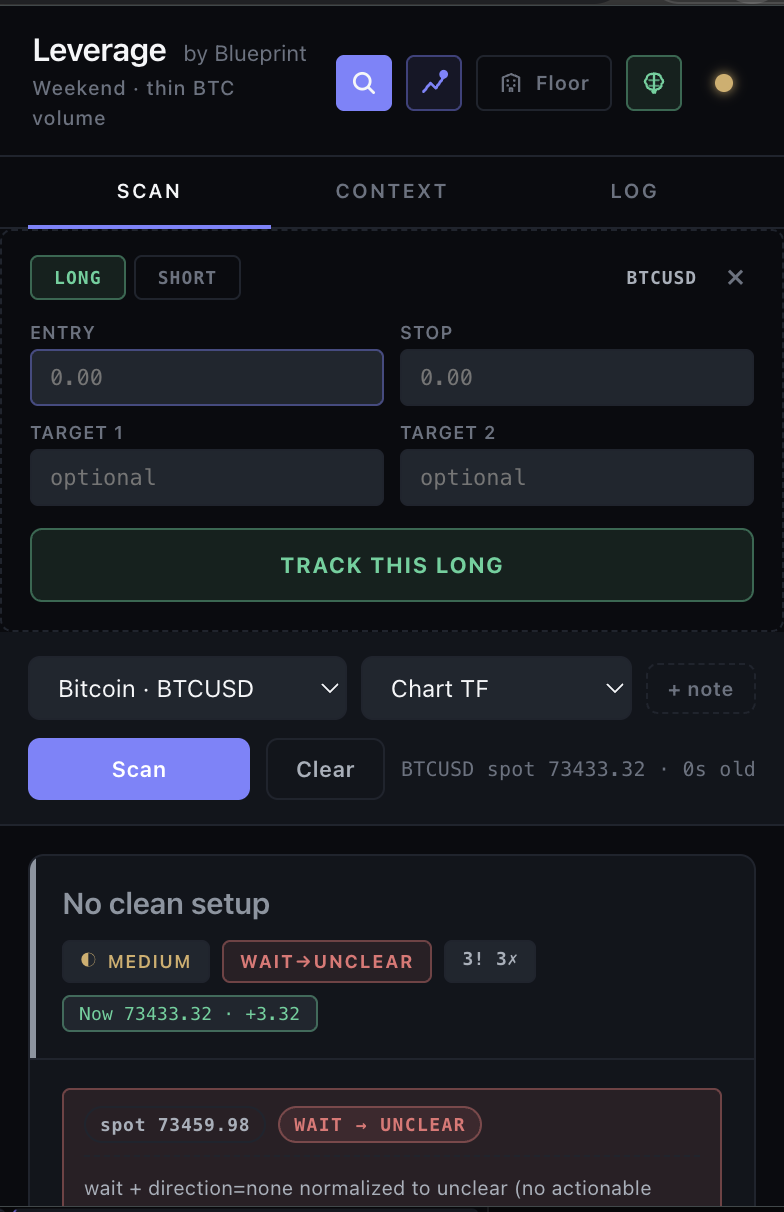
The system lives beside the chart, inside the same workflow where the user is already working. Scan a chart, get a structured verdict back in seconds: take, wait, or invalidated, with direction, entry, stop, and targets. The read includes a plain-language headline so there is something to actually push back against if the system sees something differently. That friction is intentional. The goal is not a system that tells you what to do. It is a system that makes you faster at deciding what you already know.
The session awareness matters more than it sounds. A chart at 8am London and the same chart at 3pm London are different things. The liquidity profile is different. The participants are different. The setups that make sense are different. A system that does not understand that will produce reads that are technically correct on the chart and wrong for the moment. We built session context into every read from the start: London open, NY overlap, killzones, session transitions. The system is not pattern-matching against a chart in isolation. It is reading a chart inside a market.
Getting the architecture right took longer than building the feature set. Making sure the system was getting a clean, uninterrupted signal. Making sure it did not interfere with the user's active session. Making sure the output structure was consistent even when the market conditions were not. Each of those problems was invisible until it was not.
The first real-world test came on a Friday night. One of our beta users ran a scan on gold, got a short read, took it. The setup played out. The next morning we started building everything else.
Since the closed beta opened, the feedback has been consistent: the value is not that the system is always right. It is that having a structured second opinion at the speed of the decision changes how confident you feel in the setups you do take. That is the use case. Still closed beta. Beta requests go through the site.