
The call can be right on time and the trade can still arrive late.
A notification lands. Someone unlocks a phone, opens MT5, finds gold, checks the direction, enters the volume, copies the stop, copies the target. The chart keeps moving through every one of those gestures. By the time the order reaches the broker, the price on the card may already belong to a different moment.
There is a quiet amount of work hidden inside the word "take."
Leverage has spent its recent betas learning to carry an idea through a session. The map supplies context. Pulse looks for a decision. The Floor keeps the call visible. Telegram carries it into the room. Yet the last part still depended on a person translating a published plan into an order, often while watching the same price they were trying to enter.
We brought Auto back because that distance deserved engineering too.
This is not a declaration that Leverage has become too good to need a human. We have enough difficult sessions in the book to know better. A poor call does not become a better call because software enters it promptly. It becomes a poor call with a fill. Bringing execution closer to the signal makes that responsibility more immediate.
The reason to do it is consistency. The same published direction, the same original stop, the same first target, and a risk amount chosen before the notification arrives. Less copying under pressure. Less arithmetic performed with one eye on a moving candle.
That is the version of Auto worth returning to.
The boundary is a fresh call.
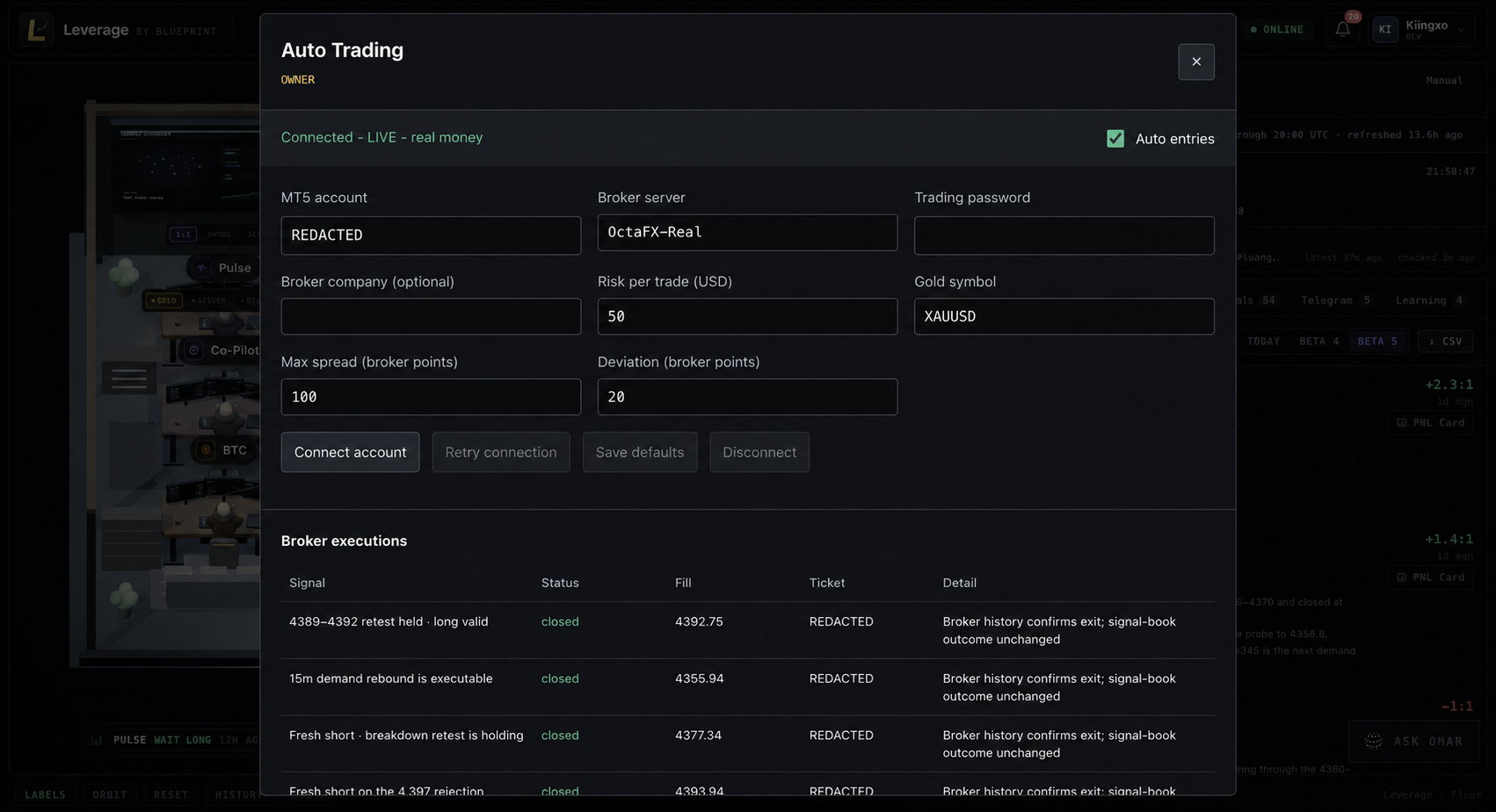
In the current implementation, Auto listens for eligible new Pulse TAKEs on XAUUSD. A WAIT does not become an order. Opening an old signal does not replay it. Connecting an account does not turn execution on. The account has to be verified, the risk amount saved, and Auto entries explicitly enabled.
When a fresh call qualifies, the entry is a market order at the broker's current ask for a buy or bid for a sell. It does not sit waiting for the published entry range to come back. That range remains part of the signal's reference plan. The broker quote is the price available to the account now.
There are still limits. If the quote is stale, the spread exceeds the saved limit, or the original stop and first target no longer make sense at the executable price, the order is rejected. Auto does not squeeze the stop to rescue the arithmetic. Each connected account allows only one outstanding copy at a time. An existing position or pending order in the dedicated account prevents another entry.
Immediate does not mean unconditional.
The other change is the unit the trader chooses.
A fixed lot size looks consistent on an order ticket. It can mean very different exposure from one setup to the next. A stop three points away and a stop ten points away do not put the same amount at risk just because the volume field has not changed.
Auto now starts with a cash risk amount in the account's currency. MT5 calculates the estimated loss between the current entry price and the original stop for a known volume. Auto scales from that estimate, rounds down to a volume the broker accepts, and checks the resulting risk again.
For an illustrative calculation, if one lot would lose 200 account currency units at the stop, a budget of 50 implies 0.25 lots. If the same calculation returns 400, the budget implies 0.125 lots. With a volume step of 0.01, that becomes 0.12, not 0.13. The rounding belongs on the side of the budget.
The calculation uses the broker's contract information and currency conversion. It does not assume that every gold symbol has the same contract. If the budget cannot support the broker's minimum volume, Auto declines the order. It does not quietly raise the budget.
This work stays on the execution path. There is no extra model conversation to decide the lot size and no new wait for an entry range. The quote and size are checked again before submission. That keeps the calculation close to the price it is meant to describe without pretending that latency, spreads, or slippage disappear.
The cash amount is planned exposure to the stop. Gaps, execution costs, and slippage can still make the actual loss larger.
Then there is the part nobody puts in the announcement.
Sending an order and knowing what happened to it are different jobs.
During the MT5 work, a direct terminal submission could succeed while the route from Leverage still failed to return a conclusive order receipt. That was a useful failure. It made it impossible to confuse "the terminal can trade" with "this exact signal has been copied and verified."
A timeout is an uncomfortable state. The broker may have received the request even when the application has not received the answer. Sending it again to make the interface look responsive can create a second position.
Auto keeps a durable record of each submission. If the result is uncertain, it marks the attempt unknown and prevents an automatic resubmission. The exposure must be reconciled before another attempt. The system has to tolerate an unresolved answer without turning that uncertainty into another order.
The interface owes the trader that distinction. Connected is not filled. Sent is not confirmed. Unknown is not permission to try again.
Protection follows the same rule.
Leverage issues a protection update when a tracked trade reaches one unit of risk in its favour or 80 percent of the distance to the first target, whichever comes first. Auto can move the verified copied position's stop to its actual broker entry price.
It preserves the target. It leaves a tighter stop alone. It does not move stops on unrelated manual positions. After requesting the change, it reads the broker position back before calling the protection applied. A message in Telegram is an instruction. The broker's position is the evidence that it happened.
The signal's reference entry and an account's actual fill can differ. Auto uses the opening price of the verified broker position for break even, not an edge of the published entry range. That protects the trade the account actually holds. Commission, swaps, gaps and slippage can still leave a net loss; an entry-price stop is not a promise of a zero-cost exit.
The Floor's signal book and the account's execution record are separate for the same reason. One describes the call. The other describes what the broker actually did. We do not get to merge them just because the cleaner number is easier to publish.
Auto also has a narrow relationship with the part of Leverage that thinks.
It does not rewrite Pulse's reasoning, promote a setup family into a confidence score, or create more TAKEs to keep the account busy. It handles the execution of an eligible call under the saved settings. The work on selection remains its own problem, with its own losing days and its own evidence to answer to.
This remains an owner-access beta, now with multiple connected MT5 accounts. Each account has its own risk amount, connection status and Auto entries switch. Adding one does not grant it permission to trade. It is not a general rollout to every MT5 user. Live account connections are supported, but broker permissions still matter. Pausing Auto stops new entries while protection of an existing verified copy can continue. It does not close a position on the trader's behalf.
We brought it back with a smaller promise than the word automation usually carries.
A chosen amount. A fresh call. An order that can be traced. A stop change that has to be checked. Enough restraint to leave the account alone when the system cannot establish what happened.
There is still judgement before the order and responsibility after it. Auto takes care of the work in between.
Blueprint Labs
Leverage remains experimental. This article is a product and engineering note, not personalised financial advice. Trading can result in loss of capital. Signal results are not guaranteed account returns, and past performance does not guarantee future results.