
A scanner can tell you there is a setup. It cannot tell you whether you should take it, where the limit should sit, what invalidates the idea, or whether you are chasing into a level that already played out. Professional traders know this. The gap between a signal and a decision is where most of the actual work lives.
Leverage started as Pulse: an AI scanner that watches charts on a schedule and produces structured trade ideas when something looks actionable. That was useful. It still is. But after months of closed beta and daily sessions on gold, indices, and BTC, the feedback kept pointing somewhere else. Traders did not only want ideas pushed at them. They wanted something beside the chart that could reason with them while the session was moving.
That became Co-Pilot.
Why signals are not enough
Signals compress a complex market into a verdict. Take, wait, invalidated. Direction, entry, stop, targets. For many workflows that is exactly what you need: a fast second read when the candle is closing and you do not have time to re-derive the whole picture.
But a professional session is not a sequence of isolated signals. It is planning limits before price gets there. Debating whether a short is still valid after a flush. Asking whether a demand zone is sensible or whether you are late. Managing an open idea as structure shifts. Updating invalidation when the chart changes but your thesis has not.
Those questions are conversational. They need context that persists while you click around TradingView, change timeframes, draw levels, and wait. A popup that fires a read and disappears does not fit that workflow. A chat box floating over the chart does not either. You need a panel that stays open, stays aware, and stays out of the way of the chart you are actually trading.
From Pulse to Co-Pilot
Pulse remains the scanner layer. It watches, schedules reads, and surfaces ideas when the system thinks something is worth your attention. Co-Pilot is the professional trading partner layer built on top of the same infrastructure.
The distinction is task type, not model quality. Pulse answers: is there something here worth looking at? Co-Pilot answers: given where we are in this session, is this short valid, where should the sell limit sit, what kills the long, am I chasing, does this level still matter?
Co-Pilot is not a generic assistant bolted onto a trading product. Its personality is Leverage. It speaks in the same language as the reads: levels, invalidation, session context, structure, risk. It is designed to feel like the same system you already trust for chart interpretation, extended into a back-and-forth rather than a one-shot output.
A trading partner beside the chart
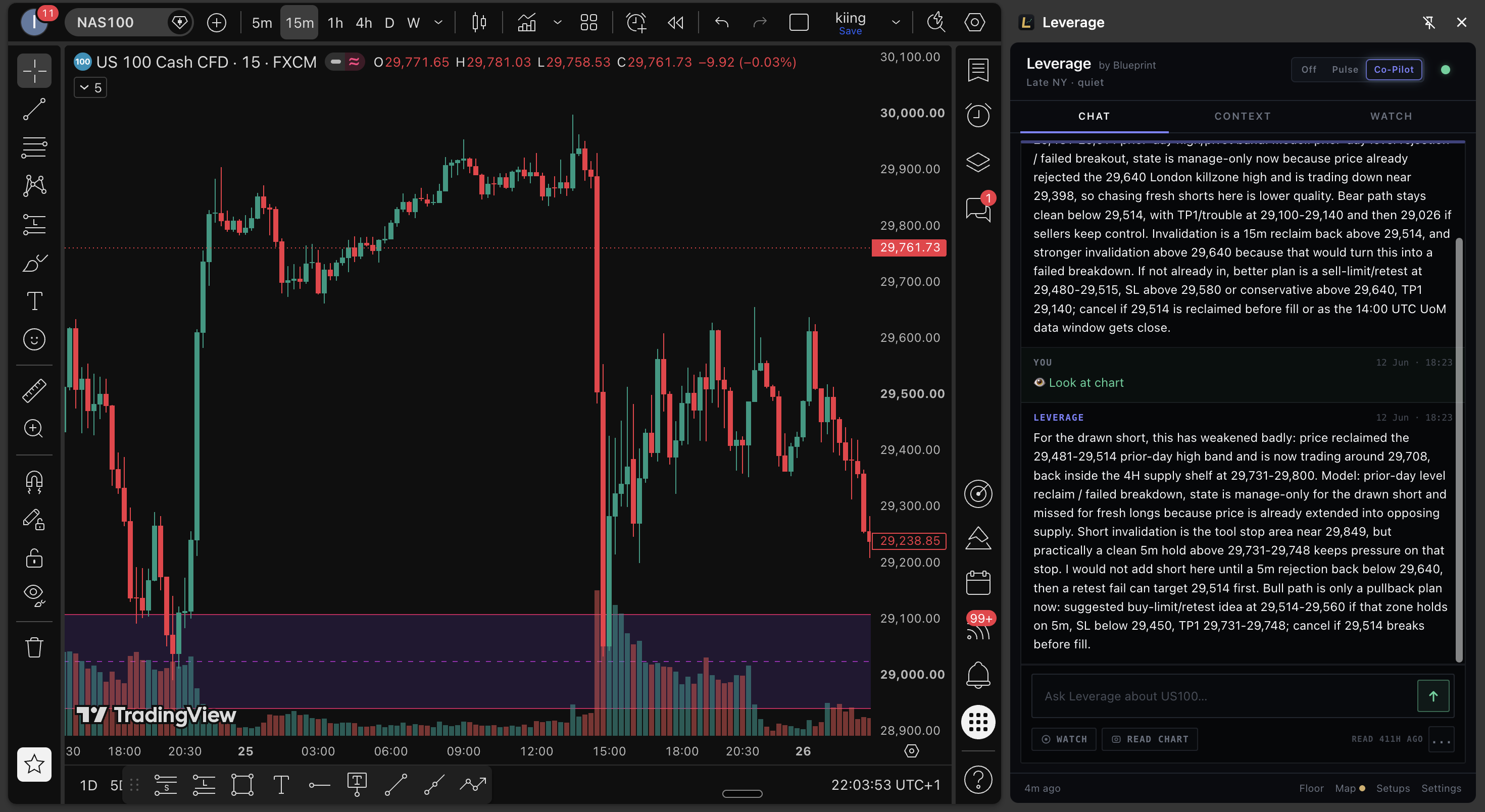
Co-Pilot lives in the Leverage side panel, docked beside TradingView. That was a deliberate product decision, not a layout default.
Traders need persistent context while they work. They change symbols, flip timeframes, scroll back through the session, adjust drawings, and come back to the same open question ten minutes later. A side panel that stays in place matches that rhythm. The chart stays primary. Co-Pilot stays available without covering the thing you are trying to read.
When Co-Pilot is active, it knows the current asset, the active session, and the market context assembled for that symbol. On BTC that includes live market conditions and relevant news. On gold and indices it includes session timing, liquidity windows, and the higher-timeframe map you have saved. It can see whether you have an active plan in play and reason within that frame instead of treating every message as a cold start.
Reading the chart without taking over
Co-Pilot can read the chart when you ask it to. Watch and Read chart are explicit actions, not background surveillance. You trigger the read when you want Leverage to look at what is on screen and reason from it.
That matters for trust. The system is not pretending to see things you did not ask it to see. When you say look at the chart, it captures the live TradingView view and works from that structure: prior-day bands, supply shelves, demand zones, failed breakouts, the messy middle of a session after a flush. The output reads like a desk conversation, not a template.
Co-Pilot supports active trading conversations without pretending to execute trades automatically. It is decision support. It helps you think through entries, limits, invalidation, stop placement, targets, and trade management. It does not place orders. It does not guarantee outcomes. It does not replace your judgment.
Debate, not blind agreement
One of the fastest ways to lose trust in an AI trading tool is sycophancy. You propose a trade. The system agrees. Price moves against you. You ask again. It agrees again, differently.
Professional traders do not need a yes machine. They need something that will push back when the chart does not support the story, when the entry is late, when invalidation is vague, when the limit you are planning sits inside noise instead of at a level that actually matters.
Co-Pilot is built for that kind of friction. Is this short valid? Where is the sell limit? What invalidates this long? Am I chasing? Is this demand zone sensible? Those are normal questions in the panel, and the answers are allowed to be uncomfortable.
Session context can persist across a live conversation so you are not re-explaining the same plan every message. Session resets and journals exist to keep the workflow clean when you move on. The goal is continuity during a session, not an endless memory dump that confuses the next day’s read.
Built for professional workflow
Leverage is a small product with distinct layers that map to how traders actually work:
Pulse is the scanner. Scheduled and on-demand reads that surface ideas when structure looks actionable.
Co-Pilot is the professional trading partner. Persistent side-panel conversation grounded in asset, session, map context, news where relevant, and your active plan.
The Floor is the visual command center. Agent activity, scan rhythm, and session state made visible when you want the system feel, not just the text output.
Map and context are the higher-timeframe awareness layer. Multi-timeframe notes per asset, carried into reads and Co-Pilot conversations so the AI is not pattern-matching a single screenshot in isolation.
Watch and Read chart are the chart-aware interaction primitives. Explicit triggers that tie conversation back to what is actually on your TradingView screen.
Together they are one workflow: scan when you want ideas, co-pilot when you want reasoning, floor when you want visibility, map when you want structure that survives across the session.
What comes next
Co-Pilot is in active development inside the closed beta. We are tightening how session context flows into conversation, how reads and chat stay coherent when the chart moves, and how much pushback is useful without becoming noise.
The direction is clear: Leverage should feel like a serious tool for people who already know how to trade and want a second brain beside the chart, not a signal vending machine promising certainty.
Leverage is a research and decision-support system. It does not provide financial advice or guarantee profitable trades.