
Most AI trading tools have a memory problem. Either they forget everything between sessions, which means every read starts cold and nothing compounds. Or they learn too aggressively from noisy outcomes, treating a lucky win as wisdom and a bad fill as proof the model was wrong about structure that was actually fine.
Both paths fail in production. Forgetting wastes the only asset you actually accumulate over time: evidence about what happened when the system said X and the market did Y. Over-learning contaminates the next decision with variance that was never signal.
Leverage is taking a slower path. Playbook Memory is an evidence-backed learning architecture built to record everything, evaluate in shadow mode first, separate paper from taken trades, exclude ambiguous outcomes, and only later allow approved memories to influence specific workflows. Nothing about this changes how Leverage trades today. That is intentional.
The problem with memory in trading agents
Trading agents sit in a harsh learning environment. Outcomes are noisy. Execution differs from the call. Timeframes disagree. A stop and a target can both get touched between polling intervals. A paper idea that was structurally sound can lose because the trader chased. A taken trade that wins can still be a bad process.
If you merge those layers too early, you cannot tell what you are learning from. If you promote every pattern the model notices, you build a playbook of superstitions. If you never record anything, you stay permanently at day one.
The design question is not whether Leverage should remember. It is what deserves to be remembered, under what evidence standard, and when that memory is allowed to affect behavior.
Why we started with shadow mode
Playbook Memory runs in shadow mode first. It records. It retrieves. It compares. It does not change prompts yet. It does not change trading behavior yet.
Shadow mode answers a narrower question than learning: would this approved lesson have matched this scan, and if it had been applied, would the outcome have helped or hurt?
That question has to be answered before any memory touches live reads. Otherwise you are running an uncontrolled experiment on traders who did not opt into being training data for a moving target.
In shadow mode, when a Pulse scan completes, the system checks which approved skills would have matched the context. It logs those shadow retrieval runs. Later, when the trade case resolves, it compares the match against the outcome. The key metric is not accuracy in the abstract. It is retrieval relevance under real market conditions.
What Leverage captures
Playbook Memory is not a single table. It is a graph of evidence objects tied together tightly enough that you can audit a lesson back to the episodes that produced it.
Episodes are every model run: Pulse scans, Co-Pilot turns, management reads, execution desk outputs. Each episode carries context metadata, the model output, and links forward into whatever trade lifecycle it touched.
Trade cases are the canonical lifecycle object for a setup, whether paper or taken. A case accumulates state over time instead of treating each scan as an isolated event.
Trade events are the transitions inside that lifecycle: proposed, taken, TP hit, SL hit, closed, edited, expired. Events are how you reconstruct what actually happened without relying on the model's memory of it.
Paper outcomes and taken outcomes are stored separately. Context metadata captures asset, session, timeframe, map state, and whatever else was true when the read fired. Retrieval runs log what the memory system would have surfaced. Candidates are possible lessons waiting for evidence. Skills are approved playbook knowledge that passed review. Evidence links candidates to the episodes and outcomes that support or contradict them.
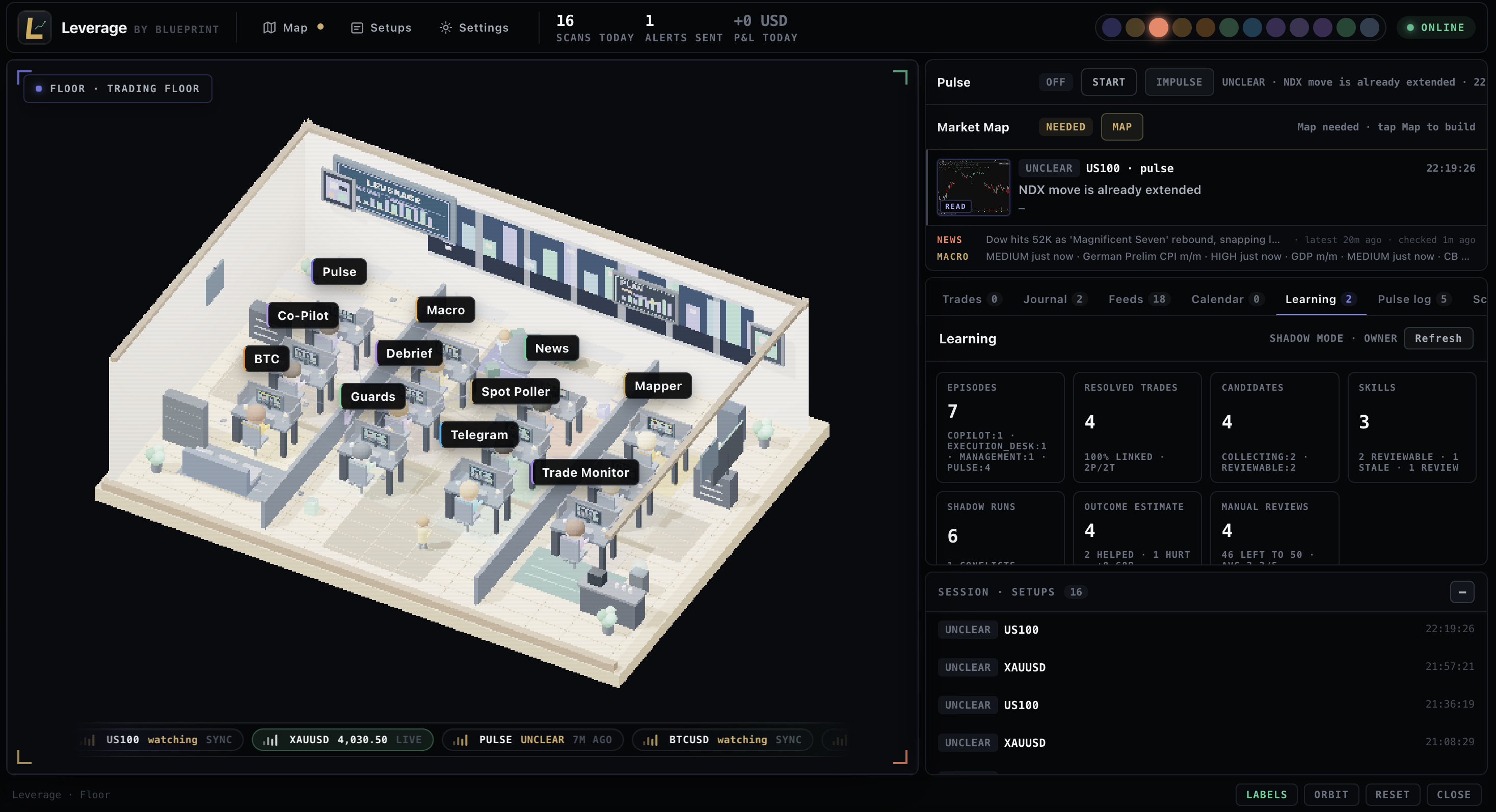
The Learning tab inside the Floor is the review dashboard for this stack. It is where shadow runs, candidate status, skill review queues, and manual ratings live. If you cannot inspect the learning loop, you cannot trust it.
Paper vs taken outcomes
Paper measures the quality of Leverage's call. Taken measures Leverage plus trader execution. Those are related but not the same random variable.
A paper short can be correct on structure and still lose on a taken ticket because the entry was late, size was wrong, or the trader faded early. A taken win can hide a bad call that survived on variance. Merge the two too early and your playbook learns the wrong lesson every time.
Playbook Memory keeps the separation explicit in the schema and in the review UI. Resolved trade counts show paper and taken distinctly. Outcome estimates can be evaluated per lane. Skills that only hold up on paper should not graduate into behavior that affects taken workflows, and vice versa, without deliberate review.
Keeping ambiguous data out
Some outcomes are not learnable yet because the system cannot resolve them cleanly. If TP and SL may both have crossed between checks, the result is ambiguous. Those cases are excluded from learning statistics rather than forced into a win/loss bucket.
That choice slows down the dataset. It is the right slowdown. A memory system that trains on ambiguous labels will confidently encode garbage. Leverage already learned the harder version of this lesson on the factual side: models should not adjudicate live price levels. The same discipline applies to learning labels.
The Learning tab
The Learning tab is the operational surface for Playbook Memory inside the Floor. It shows episode volume by source, resolved trade linkage, candidate pipeline status, skill review state, shadow run counts, and outcome estimates split into helped versus hurt.
Manual ratings matter here. Automated shadow retrieval can tell you that a skill matched. A human still has to judge whether the match was relevant to the actual decision problem. The readiness thresholds include a minimum count of manual shadow retrieval reviews and a retrieval relevance bar for exactly that reason.
Shadow mode is visible in the UI. You can see when the system is collecting versus when lessons are reviewable versus when skills are stale. Nothing is hidden behind a batch job you cannot inspect.
Why BTC Pulse comes first
Playbook Memory is being validated on BTC Pulse before it spreads across assets and workflows. BTC has the second context layer we built for live market conditions and news. Pulse on BTC is scheduled, high volume, and already instrumented under the new schema.
Starting narrow keeps the evidence chain legible. You can require at least seven days of new-schema BTC Pulse data, verify episode capture rate, verify resolved-trade linkage, run manual shadow reviews, and check expectancy on Pulse outcomes excluding ambiguous cases before you claim the memory loop works.
Those are the readiness thresholds we are holding ourselves to:
At least seven days of new-schema BTC Pulse data. Ninety-five percent or better episode capture. Ninety percent or better resolved-trade linkage. Fifty or more manual shadow retrieval reviews. Eighty percent or higher retrieval relevance on those reviews. Positive BTC Pulse expectancy with ambiguous cases excluded. No unresolved contradiction clusters in the candidate pipeline.
That is a high bar. It should be.
Memory before model training
There is an obvious temptation to skip straight to fine-tuning: collect outcomes, train a specialized trading model, ship intelligence. We are not doing that yet.
Playbook Memory is infrastructure for evidence, not a shortcut around it. The goal is a playbook of skills that survived shadow evaluation and human review, tied to retrievable context, with known helped-versus-hurt statistics on the workflows they touch.
Model training comes later, if it comes at all, on top of that corpus. Memory before behavior change. Behavior change before model specialization. Each gate exists because the previous layer failed when we skipped it.
The road to specialized trading agents
The end state is not one model that does everything. It is specialized agents with shared evidence standards: Pulse for scanning, Co-Pilot for session reasoning, management for open trades, each able to draw on approved skills where the retrieval context matches and the historical evidence says the lesson is worth applying.
We are not there yet. Playbook Memory is the foundation layer: record everything, evaluate in shadow, separate paper from taken, exclude ambiguity, review manually, promote slowly.
Leverage is a research and decision-support system. It does not provide financial advice, and memory does not guarantee profitable trades.