
A security tool that can write is a different problem from a security tool that can look.
Models are good at the first one. Ask for an open redirect and you will get a paragraph that sounds like a report: the parameter, the status code, the thing that would happen next. None of that has to have been in the response. The sentence can be fluent and still be a guess. In a lab that builds with models, that is the failure we have to design against. Cybersecurity and AI together are a big deal for two reasons that stack. Generated software is multiplying the surface. And a fluent assistant can turn a guess into something a team treats as evidence.
Rift is the scanner we are building for the second problem. It runs locally. It sends GET requests only. Before a scan starts, the person running it has to confirm they own the hosts or have permission to test them. The allowlist for that run comes from the hosts they submitted. It does not hand back a score. When a scan finishes, that is a record of what those requests returned.
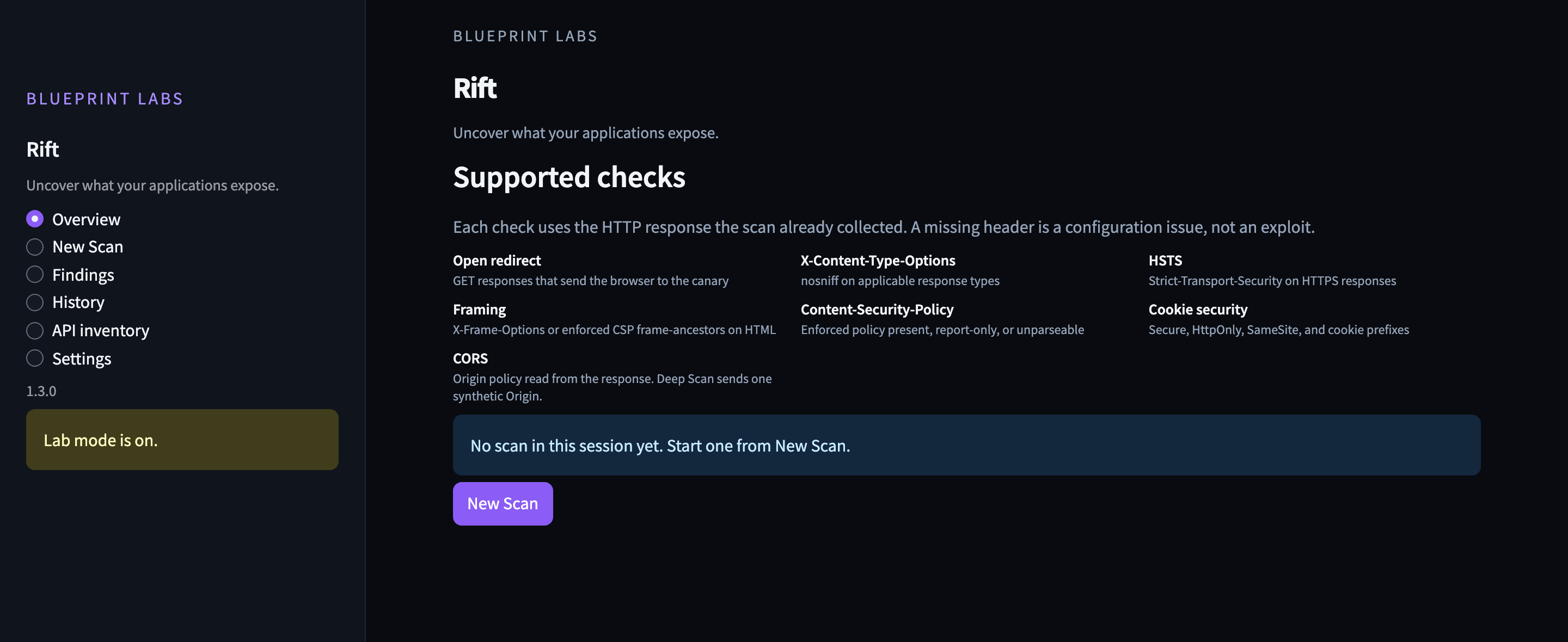
The checks that exist today read the response that is already in hand. Open redirect, under CWE-601. X-Content-Type-Options. HSTS. Framing. Content-Security-Policy. Cookie flags. CORS. Fast Scan takes the CORS headers from responses it has already collected, so that part costs no extra request. Deep Scan adds one GET. The Origin on that request is a synthetic value, https://rift-cors-check.invalid. Rift does not request that host, and it does not send cookies.
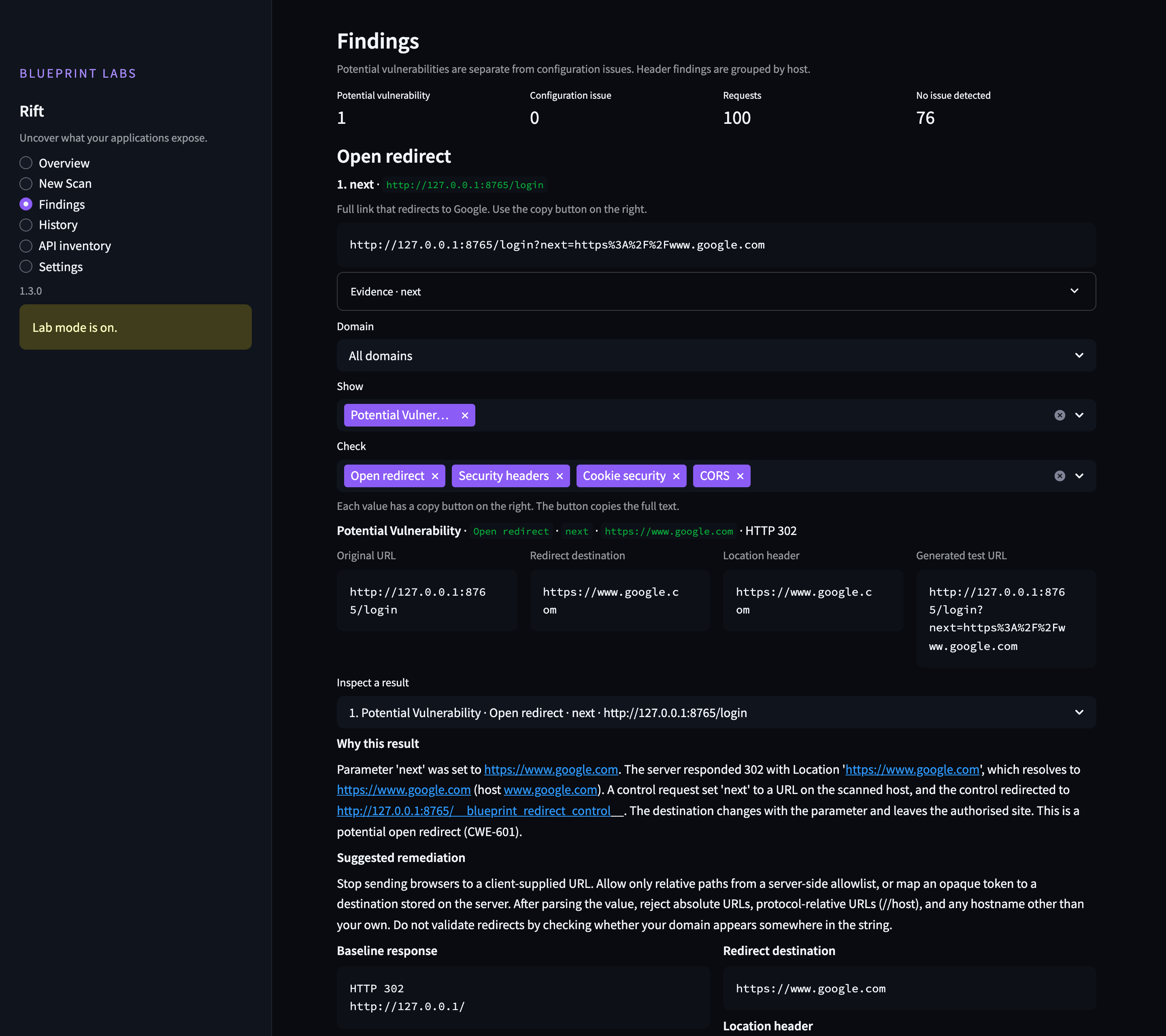
We pointed a Fast Scan at a fixture on this machine, with lab mode on. The target was http://127.0.0.1:8765/login. One hundred requests. One potential vulnerability. No configuration issues. Seventy-six rows where the check saw no issue.
The parameter was next. Rift built http://127.0.0.1:8765/login?next=https%3A%2F%2Fwww.google.com. The server answered 302. The Location header was https://www.google.com, and that is where the redirect resolved. A control request set next to a URL on the same host. That one stayed on the host, at http://127.0.0.1:8765/__blueprint_redirect_control__. The destination moved with the parameter and left the site we were allowed to scan. Rift calls that a potential open redirect. It does not call it a confirmed theft.
The page's own baseline was a 302 to http://127.0.0.1/. That redirect was already there before any test value. It is not the finding.
The explanation under the result is the scanner's, written from those two responses. The remediation on the screen is the one already in the product: stop sending browsers to a client-supplied URL, allow relative paths from a server-side list, or map an opaque token to a destination the server stores.
This was our fixture, started so we could photograph the screen. It is our login page on this machine. It is not a customer, and it is not a breach.
The model is not in that path. Rift already has a seam where an explanation provider and a remediation provider can sit later. The rule on that seam is the whole design: a later provider must not change the HTTP verdict. The scanner decides. Anything we add has to read the result.
That is the work for the coming weeks and months.
First, a model writes the explanation under a result, using the evidence the scan already stored. The verdict stays the one the response produced. If the prose and the response disagree, the response stays.
After that, a model can propose which documented parameters and operations are worth the request budget on a scan the operator already authorised. It can rank work inside that budget. It cannot add a host. Checks that need two signed-in accounts, the kind that ask whether one user can see another's data, wait until an operator supplies both accounts.
Autonomous exploitation is out. So is a score invented so the page looks finished. The bet is the narrow one. Use the model where language helps, and keep the finding tied to a response you can open.
Rift is in the lab. The page is at /rift.