
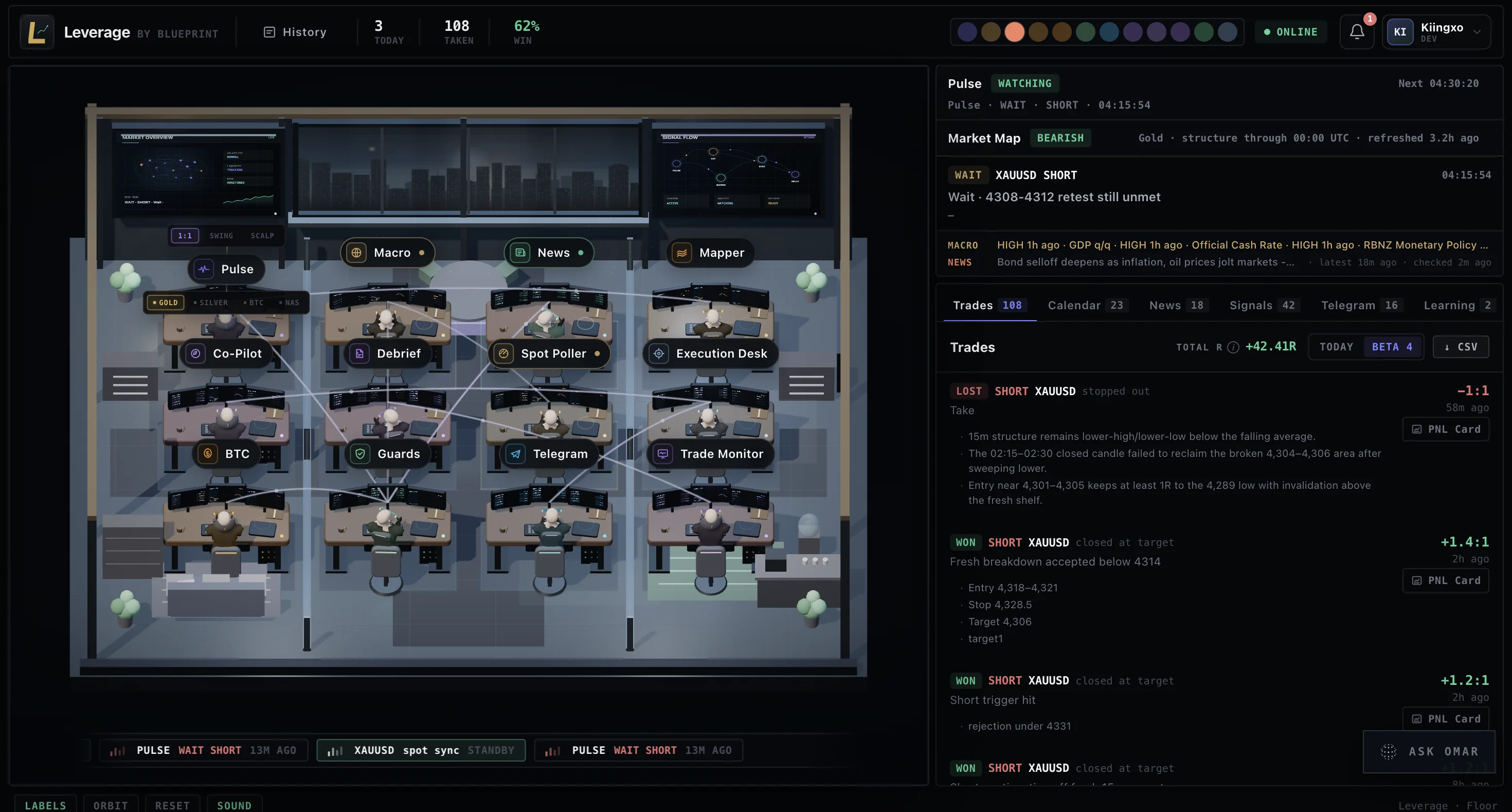
One hundred is a strange number in research. It is large enough to expose patterns that ten trades can hide, but still small enough to punish anyone who mistakes a promising record for a finished system. Leverage has now crossed that line in Beta 4, and the most useful response is neither celebration nor suspicion. It is to mark the book honestly.
Trade number 100 closed the first century at 60 wins, 38 losses, and two break-even outcomes. The ledger stood at +36.60R net. These were taken trades: calls that moved from analysis into actual tracked execution. They were not paper calls added because price later moved in the right direction, and they were not a backtest reconstructed with the benefit of hindsight.
That distinction is the milestone.
A model can produce thousands of plausible market opinions. A trading system becomes measurable only when an opinion is attached to an entry, invalidation, target, timestamp, and outcome. Beta 4 forced Leverage to live inside that accounting. The system did not get to keep its elegant reads while forgetting its poor entries. A missed move remained a miss. A stop remained a loss. A target counted only when the tracked trade reached it.
The first hundred did not arrive in one kind of market. July established the opening record with 27 taken trades. August expanded the sample by 65 trades and then became the hardest part of the beta. The book stayed positive, but its judgement became less dependable in the second half of the month. Entries appeared from weak locations. Momentum was sometimes recognised late. At other times the desk waited for a pullback that the market had no obligation to offer.
Those difficult weeks matter as much as the winning runs. A system observed only in favourable conditions is not being tested; it is being photographed. August made the weaknesses repeat often enough to investigate. It pushed us to improve how Leverage carries market context into a decision, how it distinguishes a valid continuation from an exhausted move, how it records an outcome, and how the trading floor keeps the same ledger across the extension, web application, backend, and Telegram desk.
September then carried the book across 100. The stronger proof came on the opening day itself. On Tuesday 1 September, thirteen taken trades produced ten wins and three losses for +12.08R. That was not a short lucky run. It was a full session from the first London hour through the evening: one early long loss, then twelve short decisions across the day, with ordinary winners between 1.05R and 1.89R and no single trade rescuing the book. That opening did not erase August, and it did not prove that every correction worked. It did show that the system could return to making well-located decisions without needing one exceptional trade to rescue the period.
The current live snapshot has already moved beyond the round number. At the time of writing, Beta 4 contains 108 taken trades: 67 wins, 39 losses, and two break-even outcomes. Excluding break-even trades, the resolved hit rate is 63.2 percent. Net performance stands at +44.57R. September currently accounts for sixteen entered trades, thirteen wins, two losses, and +17.41R, with the opening day on 1 September contributing thirteen trades, ten wins, three losses, and +12.08R of that total.
Those figures are encouraging. They are not a promise.
A hundred trades can support better questions, but it cannot answer every one of them. Results remain dependent on the market regime, execution quality, spread, slippage, and the discipline of the person taking the call. The sample is also one instrument-focused beta, not evidence that the same behaviour transfers automatically to every market. There is still more work to do on setup families, loss clustering, confidence calibration, and the difference between a genuinely bad trade and a valid trade that simply lost.
The purpose of Beta 4 was never to produce a perfect win rate. It was to turn Leverage from an impressive reader of charts into an accountable operating system for a trading desk. Accountability changes the engineering. It means the interface cannot display paper performance as taken performance. It means an overnight trade belongs to the day it was called even if its target arrives after midnight. It means a failed Telegram delivery cannot erase a trade that extension users actually entered. It means a corrupted price observation cannot be allowed to turn one stopped trade into an impossible multi-R loss.
These details are not administrative work around the product. They are part of the product. Intelligence without a trustworthy ledger is theatre.
Crossing 100 trades gives Blueprint Labs something more valuable than a headline. It gives the research enough history to compare periods, inspect recurring mistakes, and challenge confident explanations with recorded evidence. It also gives us a clearer standard for the next hundred. The goal is not simply more trades. It is a more dependable relationship between context, decision, execution, and outcome.
The first hundred says that Leverage can produce a positive book across imperfect months. It also says the edge is not smooth, the system is not finished, and good weeks must not be allowed to rewrite bad ones. That is a useful result. It is the kind of result a research product should be built on.
One hundred trades are now on the record. The next hundred have a harder job: prove that what we learned can hold.
Leverage is a research and decision support system. This note documents observed beta performance and engineering work. It is not investment advice.