
August did not leave quietly. It left a ledger, a set of difficult charts, and a month of questions that could not be answered with one more line of code or one convenient explanation. At Blueprint Labs, it will be remembered as the month that marked the book and tested the machinery behind it.
Leverage had entered Beta 4 with evidence that it could read gold well. August challenged that confidence. Calls arrived from poor locations. Clean movement passed while the desk waited. Some entries were technically defensible and financially weak. Others were simply wrong. The hardest part was not that Leverage lost trades. A trading system that cannot lose is a sales story, not a system. The harder fact was that, for stretches of the month, the losses and misses stopped feeling independent. They had a shape.
This is the month end note on that shape, on the price action that revealed it, and on a September opening session that has given the research a better first page.
## The ledger and the lie it could tell
August recorded 65 taken trades. Of the 63 that resolved as a win or a loss, 35 won and 28 lost. Two closed at break even. The hit rate was therefore 55.6 percent. The book finished at approximately +15.69R, with a profit factor of 1.54. The average winner returned 1.28R and the average loss cost 1.04R. Peak to trough drawdown reached 4.95R.
A positive closing number can tell a flattering story. This one should not.
The first half of August produced a 66.7 percent hit rate and about +14.47R. The final two weeks fell to 41.4 percent and finished almost perfectly flat at about 0R. One exceptional 4.04R winner carried a material part of the monthly result. The ledger survived because the payoff on winning trades was larger than the cost of losing ones. The decision process, however, had plainly lost consistency.
That distinction is financial, not cosmetic. A book can remain green while its edge is thinning. Positive return does not excuse poor location, repeated hesitation, or a concentration of losses in the same family of decision. August was Leverage's hardest month to trust in this beta not because the closing number was weak, but because the quality beneath it became less dependable.
## August price action: generous movement, expensive clarity
Gold did not spend August asleep. Across the chart record observed by Leverage, price moved from roughly 4,045 at the first full session to about 4,451 at the close of the month, an advance of approximately ten percent. Inside that journey it traded as low as 4,026 and as high as 4,681. More than 650 points separated the observed extremes. There was enough movement. The problem was converting movement into well located risk.
The tape changed character repeatedly. Early strength became vertical expansion. Expansion became balance. Balance produced false acceptance, fast rejection, and several sessions where the larger trend and the immediate auction told different truths. Daily structure could remain constructive while four hour structure rolled over. A clean fifteen minute break could occur directly into higher timeframe demand. A valid pullback idea could become invalid simply because price had already used the level too many times.
August punished analysis that was right in direction but wrong in place. It also punished the opposite error: respecting a broad zone so much that the live trend was allowed to travel without us. Leverage sometimes waited for an ideal pullback after the market had already accepted a continuation. At other times it treated a shallow shelf as sufficient protection for a stop that the session's ordinary volatility could reach.
The month made one principle impossible to ignore. Location is not a decorative paragraph beneath a trade idea. It is part of the trade. A bearish read inside active demand is not the same proposition as a bearish read beneath demand after a failed reclaim. A bullish read inside supply is not improved by confident language. The price at which an idea becomes risk is where analysis enters the ledger.
## What the drawdown said about the system
The investigation did not reveal one dramatic failure. It revealed several smaller disagreements that could compound. The execution chart, the higher timeframe map, the current market state, and the memory of the previous setup were not always describing the same moment. That is how a system can sound coherent and still arrive late. Each sentence may be sensible while the complete decision is stale.
We returned Pulse to a stable fifteen minute execution view. We made the Market Map automatic and more explicit about active demand, active supply, tested zones, and levels whose role had changed after acceptance. We narrowed the influence of old directional ideas when current structure invalidated them. We removed experimental strategy surface that had added explanation without proving better decisions. We also made the trade record more reconstructable, so a losing call can be reviewed against what the desk actually saw rather than against a perfect chart drawn after the fact.
These are engineering corrections, not promises of accuracy. They do not tell Leverage to manufacture more calls. They improve the contract between perception and decision. The system should be allowed to wait when there is no trade, but the reason for waiting must remain attached to a level that can actually trigger. It should be allowed to trade against a broader regime when the local reversal is real, but not because the broader context was reduced to a sentence it could politely ignore.
Not every August loss was a defect. Some were proper ideas that the market invalidated. The purpose of the review was to separate normal risk from preventable incoherence. If every loss becomes a bug, the system becomes afraid. If every loss becomes variance, the system learns nothing.
## September's first page
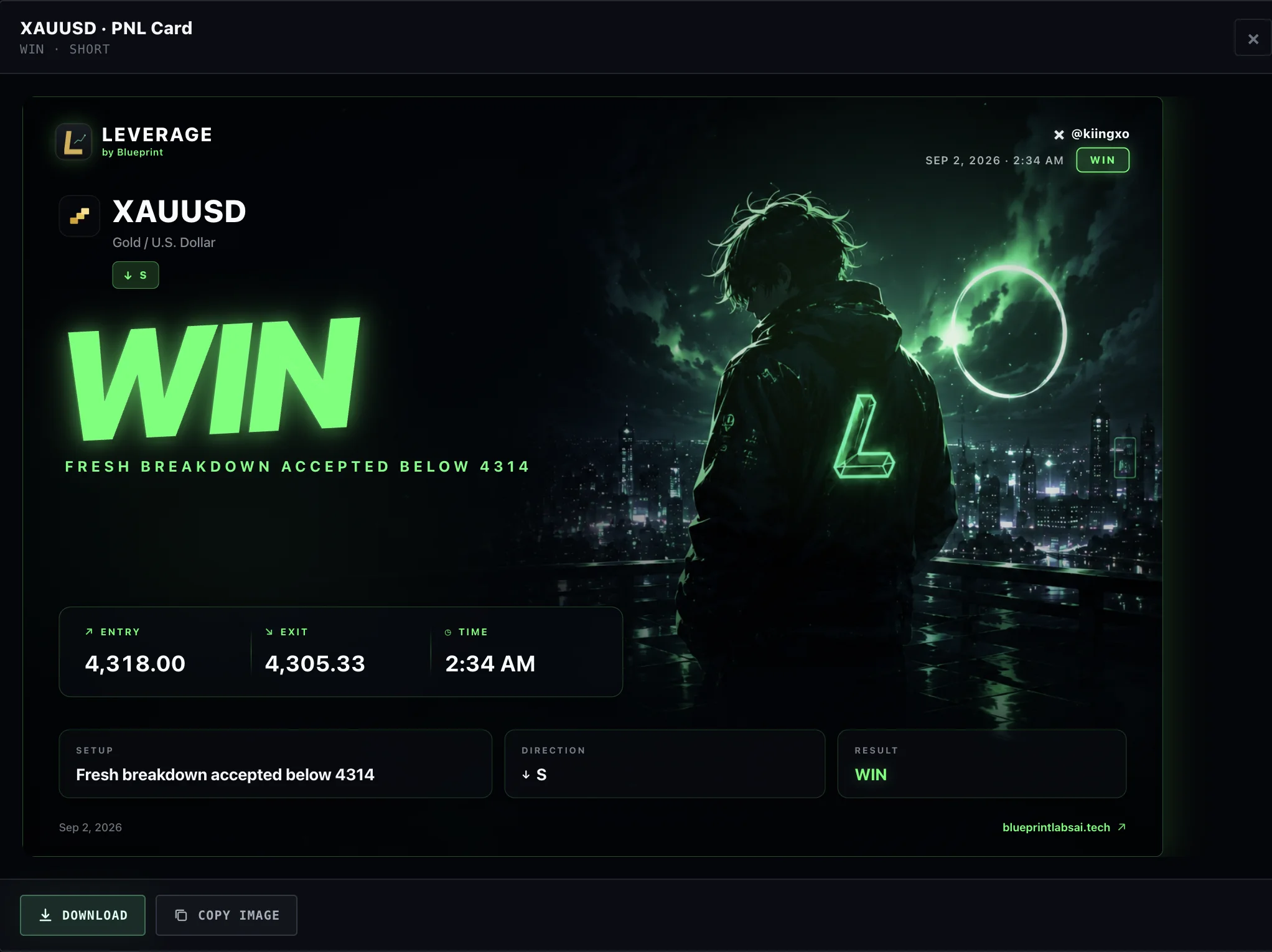
At the time of this update, the opening day on Tuesday 1 September has recorded thirteen taken trades. Ten reached target and three reached stop for +12.08R net. That single session is already almost 77 percent of August's full net R and more than ten times the +1.21R earned during August's second half. The 100th taken trade crossed inside that day with the Beta 4 ledger at +36.60R. Since then the live book has continued to grow, but the first page belongs to that full session, not to a truncated early slice of it.
The shape of that return matters more than the headline. September has not been rescued by one extraordinary payout. The ten winners on 1 September returned between 1.05R and 1.89R each. They were ordinary risk units, repeated well across a full day of decisions. The cleaner calls shared a recognisable grammar. Structure broke. Former demand was tested from beneath. Rejection held. The next liquidity pocket offered enough room to pay for the stop. Leverage did not need to predict the whole day. It needed to read the next auction correctly.
The three losses are equally important. The first long was taken against bearish four hour structure while price was sitting in supply. The second loss came from a short taken inside active four hour demand. The third was a bearish flipped resistance read whose local invalidation failed before the later continuation developed. Across the losing calls, location and the amount of room allowed for a retest still mattered. September's first lesson is therefore not that Leverage is fixed. It is that the good calls and the bad calls are becoming easier to distinguish before the outcome is known.
The price action itself has been generous to disciplined continuation. Gold sold sharply, returned to broken structure, and offered several underside retests with clear invalidation. It also produced a violent data driven reclaim that punished anyone who confused momentum with permanent direction. This is good price action in the professional sense. Not easy. Legible. It offers movement, reaction, and a place where a thesis can be proven wrong.
## A banker's reading of recovery
Ten wins across thirteen trades on the opening day are encouraging. They are not a recovery statistic.
A bank does not judge a book by its best morning. It asks how the return was distributed, how much capital had to be placed at risk, whether one outlier carried the period, and whether the same process can survive a different tape. On that basis, September's opening is healthier than August's close. The return is broad across several trades. The winners are large enough to cover ordinary losses. The strongest setup family has repeated. The system is still exposing mistakes in location, which means the work is not finished.
What matters next is stability. The execution view must remain unchanged long enough to measure. The market context must remain current. Losses must retain their original evidence. Wins must not be promoted into rules simply because they looked beautiful after target. If September continues well, it should do so through repeatable judgement, not through a month end story written backward.
August was expensive information. It proved that a positive book can still contain a deteriorating process, and that an intelligent system can lose rhythm without losing every trade. September has opened with intent. The tape has been cleaner, the best decisions have been better located, and ten targets across the opening day have put confidence back on the desk.
But confidence is inventory too. It must be marked honestly.
The first page of September is good. The month still has to write the rest.
Leverage is a research and decision support system. This note documents observed beta performance and engineering work. It is not investment advice.