
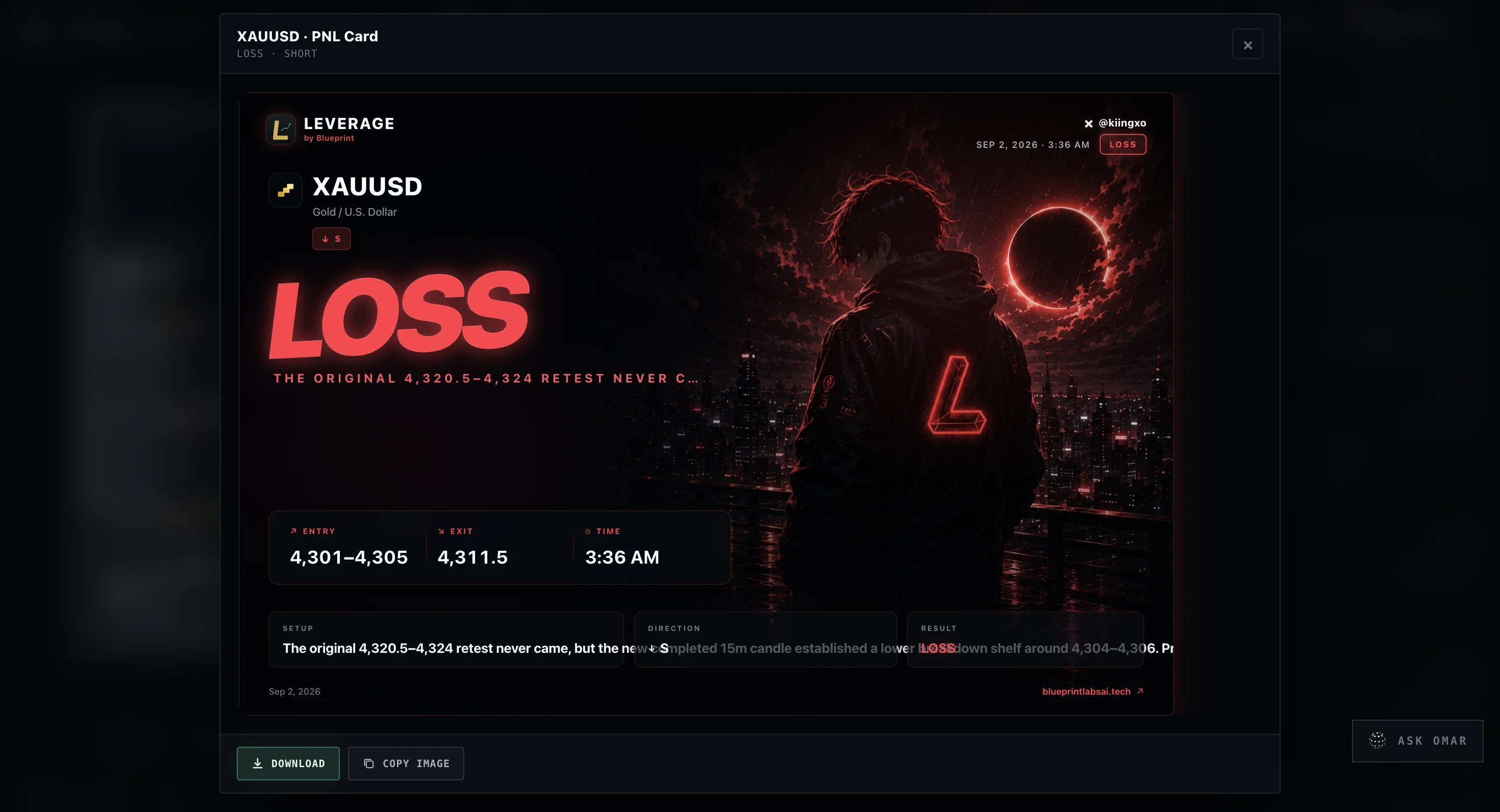
The easy post to write is the one that follows a run of winners. The charts look clean in hindsight, the product looks inevitable, and every engineering decision can be arranged into a success story. This is not that post.
Over the past two weeks, Leverage stopped feeling like itself.
The latest beta cycle had opened with a level of consistency that made the system feel settled. Then the observed hit rate fell materially. We saw clusters of stopped trades, long stretches of WAIT decisions while obvious moves developed, entries that arrived from poor market locations, and valid ideas that were recognised only after their best entry had passed. Some calls were still excellent. That almost made the problem more frustrating, because the underlying ability was clearly still there. What had disappeared was consistency.
We are not publishing a headline percentage for this period. The beta cohorts changed, historical records have been cleaned as the product evolved, and paper calls are deliberately kept separate from trades people actually took. Combining those records into one polished number would create more certainty than the evidence supports. The honest statement is simpler: the recent win rate dropped, the change was visible, and it was not acceptable to explain it away as ordinary variance before investigating the system itself.
## A trading agent rarely fails in one place
Our first instinct was to look for a single bad change. There had been several experiments around continuation entries, pullback tracking, faster reactions, and richer market context. It was tempting to identify one commit, revert it, and declare the system restored. We did revert work when the evidence did not justify keeping it. That helped, but it did not explain the whole period.
The deeper issue was compound drift.
Leverage is not a model looking at a screenshot in isolation. It is a live decision system whose quality depends on the chart, its timing, higher-timeframe location, current market conditions, the state of previous ideas, and the lifecycle of any active trade all describing the same moment. Several of those contracts had become less aligned. None was catastrophic alone. Together they could make a fluent read about the wrong version of the market.
At different points during the fortnight, we found that:
- the visible execution timeframe and the system's timing assumptions could disagree
- higher-timeframe context could be present but stale, too broad, or poorly located for an intraday decision
- a trigger could occur between scheduled observations and be classified as missed by the next one
- a previous directional idea could remain influential after the market had already invalidated its location
- a valid pullback plan could become an endless request for one more confirmation
- nearby targets and a desire for clean risk could produce plans that looked orderly but had little tolerance for ordinary noise
- operational state could lag behind the chart, creating repeated reads, delayed outcomes, or an incorrect sense that the desk was still waiting
This produced the behaviour traders noticed before any dashboard did. Leverage would describe a level well, watch price reach it, then continue waiting as the move left without us. On other occasions it would take a technically defensible setup from the wrong part of the broader range. The reasoning sounded coherent locally, but the decision was not coherent with the whole market.
That distinction matters. The system had not simply become less intelligent. Its inputs, timing, and continuity were no longer consistently agreeing on what problem it was solving.
## What we changed
The response was not to add a louder instruction telling Leverage to take more trades. That would have hidden missed entries by creating lower-quality ones. We focused on restoring trustworthy observation first.
**We standardised the execution view.** Testing across different chart speeds introduced more ambiguity than useful confirmation. Pulse now operates from a declared fifteen-minute view rather than silently inferring timing from whatever happens to be visible. The goal is not to make it slower. It is to make every claim about structure, acceptance, and candle timing mean the same thing throughout the system.
**We rebuilt the role of the Market Map.** Higher-timeframe context should answer where price is, not force an intraday direction from a distant chart. The map now refreshes automatically, carries clearer freshness, and is being shaped around useful location: nearby structure, active zones, and the difference between being at support, at resistance, or in the middle. We also corrected cases where zone roles could become misleading after price moved through them. The map is context, not a veto.
**We improved trigger continuity.** Markets do not wait for the next scheduled observation. The system now does a better job of preserving developing opportunities, recognising intrabar touches, and allowing realistic entry tolerance instead of treating a small move beyond a perfect number as a completely missed trade. This is meant to reduce both late recognition and the exhausting loop where a valid condition keeps moving one step further away.
**We made the desk more operationally honest.** Scanning now pauses when the underlying market is closed. Automatic context rebuilds retain their true freshness. The extension, the hosted Floor, and the remote workstation reconcile their state more reliably. Published calls can carry their eventual outcomes. Management messages and trade state are less likely to duplicate or remain alive after the market has already decided the trade.
**We removed experiments that increased hesitation without proving value.** This may be the most important fix culturally. More logic is not automatically more intelligence. Some attempts to track multiple entry paths created better explanations but worse decisions. Where a new layer made the system cling to stale possibilities or wait through valid entries, we rolled it back or narrowed its responsibility.
None of these changes guarantees that the next trade wins. They restore the conditions under which a win or a loss can be evaluated honestly.
## What we deliberately did not do
We did not rewrite Leverage to agree with every move after it happened.
A chart makes missed trades look obvious in retrospect. Any system can be tuned to explain yesterday perfectly and fail tomorrow with great confidence. We refused to turn each loss into a new permanent rule, especially rules that would suppress valid countertrend trades, demand a specific pattern before every entry, or force the agent to reverse simply because a position entered drawdown.
We also did not call every stopped trade a system fault. Some trades were reasonable analyses that lost. Markets can invalidate good ideas. The job of the review was to separate those normal losses from preventable failures: stale location, inconsistent timing, repeated confirmation, incorrect lifecycle state, or a plan whose risk did not fit the tape.
That separation is difficult and necessary. If every loss becomes a bug, the product becomes afraid to trade. If every loss becomes variance, the product never improves.
## What is still unresolved
The recent fixes are now live, but they are not yet evidence that performance has recovered. We need a clean prospective sample on the standard execution view, with current Market Maps and no mid-session strategy changes. The next useful result is not one winning call. It is a sequence of sessions in which calls, misses, stops, and targets can be compared under stable conditions.
Three questions remain open.
First, can Leverage distinguish healthy patience from repeated confirmation without increasing low-quality trade volume? The system should not chase movement, but it also cannot keep moving the definition of confirmation after price has already done what the prior read asked for.
Second, do stops reflect the actual structure and volatility of the session, or are apparently clean plans sometimes too fragile for the tape? This must be measured from future trades, not solved by stretching stops after a loss.
Third, does the automatic Market Map consistently improve intraday location without letting broader directional context overpower what the live chart is showing? The map is now more useful and less manual. Its contribution still has to be evaluated, not assumed.
## What these weeks taught us about applied AI
The model is only one part of an intelligent product. In a hard domain, performance is the product of perception, timing, state, context, deterministic controls, and the model's interpretation of all of them. A more capable model cannot rescue a stale market picture. A perfect chart read cannot rescue a lifecycle that believes an old setup is still active. More prompt text cannot repair a disagreement about time.
This is why Leverage remains a research project before it is a product story. The difficult periods are not interruptions to the research. They are where the real research happens. A strong week tells us that the system can work. A weak week tests whether we can explain why it did not, make narrow corrections, and resist the temptation to manufacture a prettier result.
The most valuable engineering habit during this period was reconstructability. We could inspect what the desk saw, what context was available, what it believed it was waiting for, what happened next, and whether the trade lifecycle agreed. Without that record, the entire review would have collapsed into opinions about screenshots. With it, we could find contract failures that looked like bad judgement from the outside.
The second habit was restraint. We shipped fixes, but we also reverted, froze variables, and chose observation when another patch would only make the next result harder to interpret. An agent does not become trustworthy by accumulating instructions. It becomes trustworthy when each layer has a clear job and the evidence flowing between them remains current.
## Where Leverage is now
Leverage is back on a stable fifteen-minute operating view. Market context is automatic and more location-aware. Trigger timing and entry tolerance are less brittle. Desk state is easier to reconcile across the extension, the remote scanner, Telegram, and the hosted Floor. The recent losing stretch is preserved as evidence rather than edited into a cleaner story.
Now we observe.
If the hit rate recovers, it must recover prospectively. If the same failure patterns return, we will have a clearer and more stable baseline from which to investigate them. Either result is useful. The standard is not that Leverage never loses. The standard is that we can distinguish a losing trade from a failing system, and that the system does not hide either one.
That is what the last two weeks were really about. Not protecting a win rate. Rebuilding the conditions under which the win rate means something.